AI & Agents · Full-stack
Agentic AI Chess CoachMulti-Agent Game Analysis & Personalized Learning
A five-agent AI coach that refuses to say anything the engine can't prove.
Reviews your chess games against your own history, finds the mistakes you keep repeating, and picks a whole game for you to study. Five LangGraph agents do the work; a verifier checks every claim.
- Timeline
- Oct 2026 — Present
- Status
- Live · public beta
- Stack
- PythonLangGraphFastAPIReactTypeScriptSQLDockerStockfish
- 5
- specialist agents
- 6
- LLM providers with failover
- 2-pass
- Stockfish 18 analysis
- 50+
- pytest cases
The problem
Why I built it
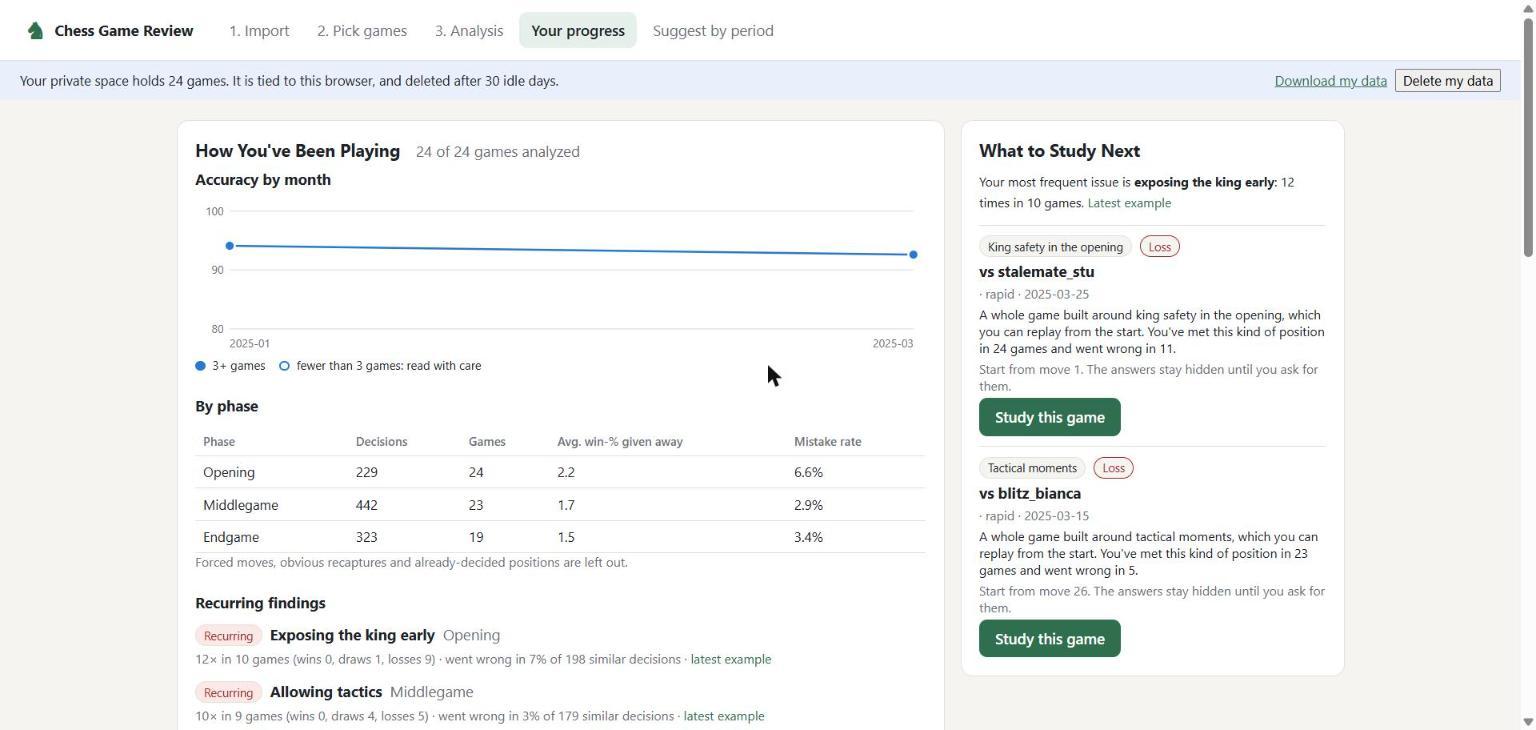
Chess sites review one game at a time, so you never see the pattern: the same kind of position going wrong across ten different games.
LLM “coaches” make this worse. They sound confident, invent moves, and quote evaluations that don't exist. A coach is only useful if every claim is grounded in what actually happened on the board.
How it works
From input to result
- 01
Import
Lichess, Chess.com or PGN upload, with duplicate detection and per-browser private spaces.
- 02
Two-pass analysis
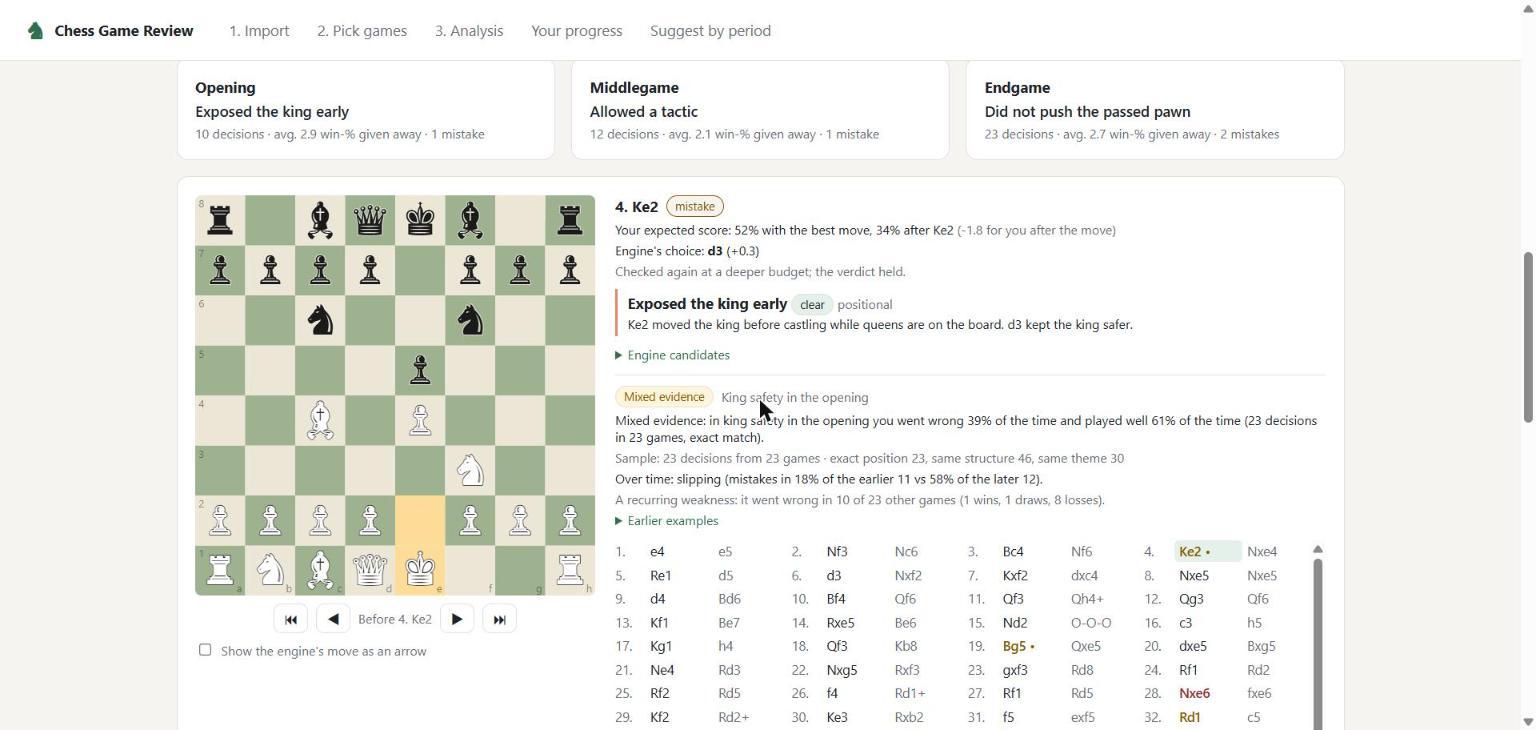
Every position gets a fast pass (150k nodes, top 3 lines); critical decisions get a deeper 600k-node pass. Disagreements are marked uncertain.
- 03
Game reviewer agent
Picks the decisions that mattered, calling tools for engine lines and board features.
- 04
History specialist agent
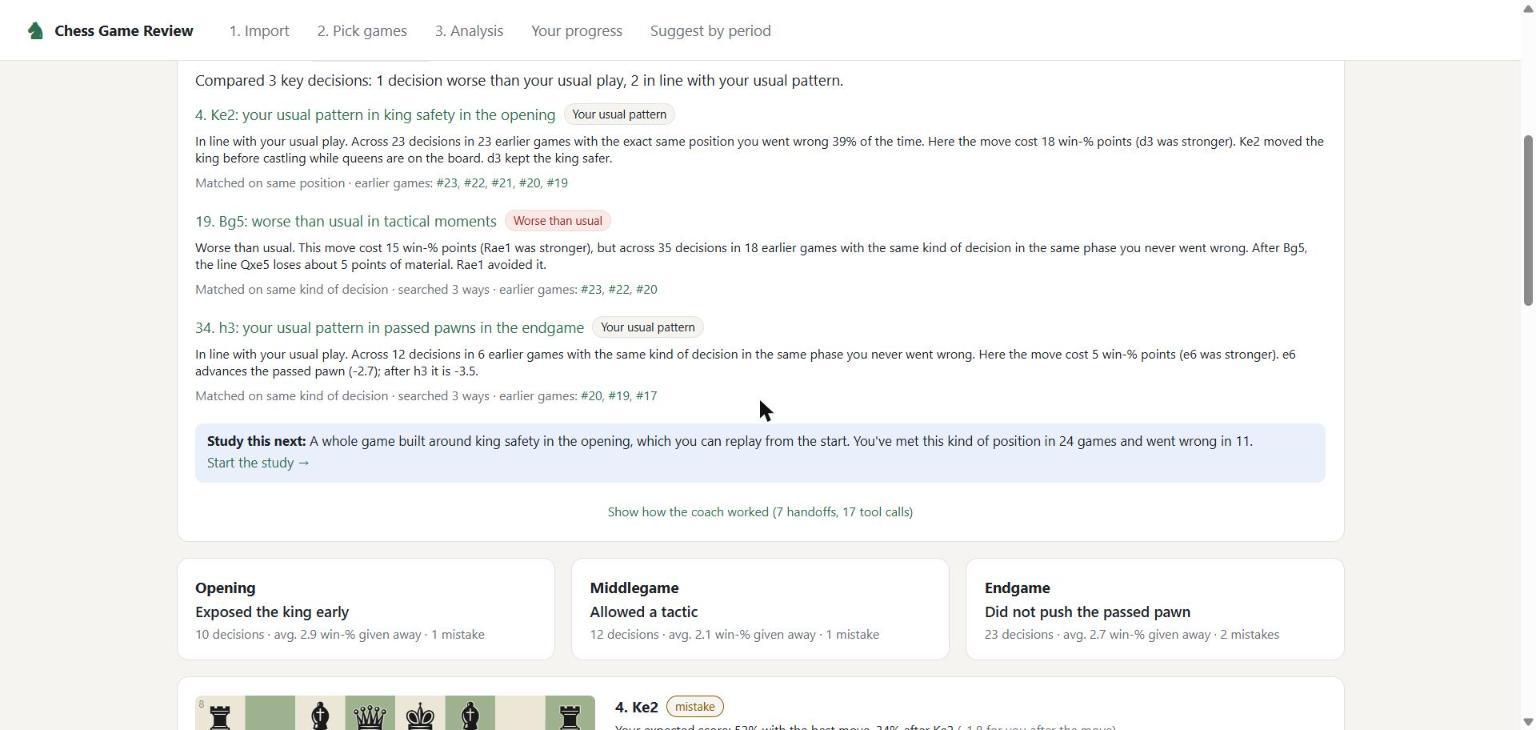
Searches earlier games: exact position, then pawn structure, then decision type. Widens the search when matches are weak.
- 05
Writer + verifier agents
The writer explains each decision; the verifier checks every move and number against stored evidence and drops what it can't prove.
- 06
Study coach agent
Picks one whole game that practises your most frequent issue, with hidden-answer checkpoints.
Engineering
Decisions worth talking about
Verification as a graph node, not a prompt instruction
Asking a model to “be accurate” doesn't work. Instead a dedicated verifier agent parses the output and rejects any move or number not present in the stored engine evidence, falling back to the rule-based explanation.
Self-correcting routing
When the history search returns a weak match, the graph loops back to search wider. If evidence is still thin, the claim is narrowed to “this game only” instead of being overstated. Handoffs and tool calls are capped so a review always terminates.
Model router with six free providers
Gemini, Groq, Cerebras, Mistral, OpenRouter and GitHub Models are tried in quality order, skipping any that is rate-limited or over budget. If none answer, the coach still works in rule-based mode.
Crash-safe job queue
Analysis jobs are claimed with a lease, and results are written in the same transaction that marks the job done, so a restarted worker never leaves half-written results.
Versioned analysis
Engine settings are pinned per analysis version so results stay comparable over months. Changing settings creates a new version and flags old games for re-analysis.
Screens
More of the product
Limits & next
What it can't do yet
- Measure the model-backed coach against the rule-based mode with the evaluation harness that already exists.
- Pilot with real players on the same sample and thresholds.
- Accounts, so a history can follow a player across devices.